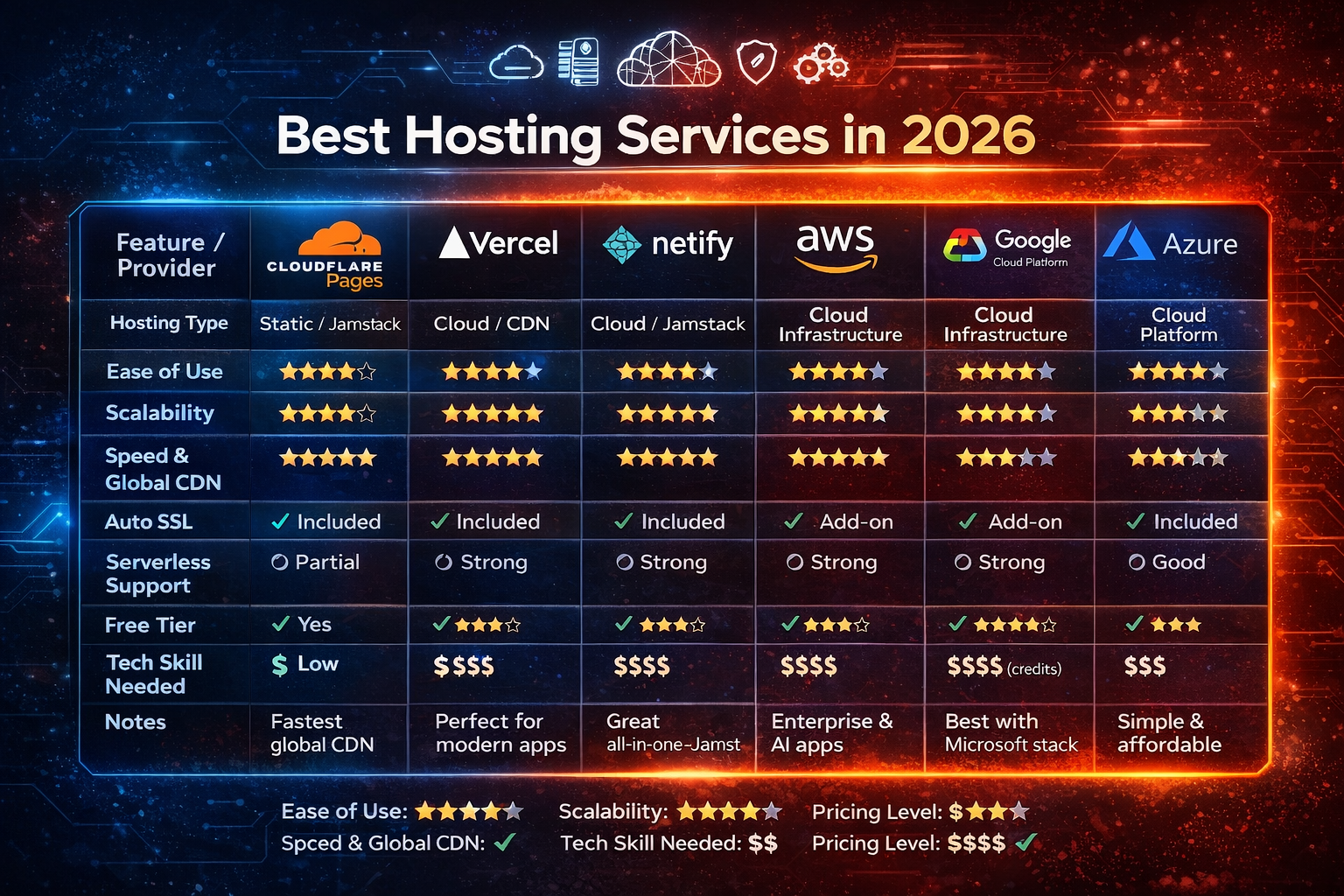
Best Hosting Services to Publish Your Website in 2026: A Complete Guide
In 2026, launching a website is easier and more powerful than ever before. But with so many hosting providers claiming to be the “best,” choosing the right one can be confusing — especially for beginners and business owners. Whether you’re launching a personal blog, an e-commerce store, a portfolio, or a SaaS product, the hosting service you pick will determine your site’s performance, uptime, security, and scalability.
In this guide, we’ll break down the top hosting options in 2026, what makes them great, and how to choose the right one based on your needs.
Why Choosing the Right Hosting Matters
Your hosting service affects:
✔️ Page load speed
✔️ Search engine ranking (SEO)
✔️ Site security
✔️ Scalability during traffic spikes
✔️ Customer support experience
✔️ Cost efficiency
Poor hosting can lead to slow pages, frequent downtime, data loss, and frustrated users. That’s why picking the best hosting provider should be a priority — not an afterthought.
Types of Web Hosting in 2026
Before exploring the best providers, let’s quickly understand the main hosting types:
1. Shared Hosting
Ideal for small websites and beginners. Low cost but resources are shared with other sites.
Best for: Blogs, basic portfolio sites.
2. VPS Hosting
Virtual Private Server offers more performance and control than shared hosting.
Best for: Medium traffic sites, small e-commerce stores.
3. Cloud Hosting
Scales resources automatically across multiple servers, making it highly reliable.
Best for: Growing businesses, apps, high-traffic websites.
4. Dedicated Hosting
You get an entire server. Best for enterprise solutions but costly.
Best for: Very large applications, huge traffic.
5. Managed Hosting
Provider handles server maintenance, updates, and security for you.
Best for: Beginners, busy business owners.
???? Best Hosting Providers in 2026
Here are the top hosting services you should consider in 2026:
1. Cloudflare Pages & Cloudflare R2
Cloudflare started as a CDN but is now a major hosting platform.
Why it’s great:
Ultra-fast global CDN
Zero downtime deployments
Automatic SSL
Serverless support
Best for: JAMstack sites, static sites, and developers seeking performance.
Pros:
✔ Free tier available
✔ Excellent global speed
✔ Strong security
Cons:
❌ Not ideal for dynamic server apps without serverless functions
2. Vercel
Vercel has become a favorite among developers thanks to its optimized support for modern frameworks like Next.js, React, and Svelte.
Why it’s great:
Automatic scaling
Instant rollbacks
Simple Git integration
Built-in global CDN
Best for: React/Next.js apps, front-end projects.
Pros:
✔ Easy deployment (Git push)
✔ Frequent free updates
✔ Excellent performance
Cons:
❌ Pricing increases for heavy serverless usage
3. Netlify
Netlify remains one of the most powerful hosting platforms for modern web apps.
Why it’s great:
Continuous deployment
Serverless functions
Form handling built in
Global CDN
Best for: JAMstack, static sites, headless CMS sites.
Pros:
✔ Free tier with HTTPS
✔ Easy setup
✔ Integrated developer tools
Cons:
❌ Might require configuration for backend APIs
4. AWS (Amazon Web Services)
AWS is still the enterprise gold standard for hosting and cloud computing.
Why it’s great:
Massive global infrastructure
Highly scalable
Strong security
Flexible pricing
Best for: Large businesses, scalable SaaS apps
Pros:
✔ Incredible flexibility
✔ Professional DevOps support
✔ Wide ecosystem
Cons:
❌ Can be complex for beginners
5. Google Cloud Platform (GCP)
Competes directly with AWS, and offers powerful tools especially for AI and analytics powered apps.
Why it’s great:
Global infrastructure
AI / Machine learning tools
Easy integration with Firebase
Best for: Advanced apps, enterprise solutions
Pros:
✔ Scalable
✔ Innovative tools
✔ Fast global hosting
Cons:
❌ Billing and services complexity
6. Microsoft Azure
Azure is ideal if your business already uses Microsoft products or .NET applications.
Why it’s great:
Seamless Microsoft ecosystem
High compliance standards
Good enterprise support
Best for: .NET apps, large corporate systems
Pros:
✔ Enterprise security
✔ Excellent enterprise roadmap
Cons:
❌ Pricing can be complicated
7. DigitalOcean App Platform
DigitalOcean is known for simplicity and developer-friendly cloud services.
Why it’s great:
Simple UI
Predictable pricing
Scales automatically
Best for: Startups, small apps, developers
Pros:
✔ Affordable
✔ Easy to manage
✔ Great documentation
Cons:
❌ Less feature-rich than AWS/GCP for some advanced needs
How to Choose the Best Hosting in 2026
Here’s a simple decision guide:
✅ Choose Shared Hosting if:
You’re on a tight budget
You are launching a simple site
✅ Choose Cloud Hosting if:
You expect traffic growth
You want reliability and fast performance
✅ Choose Managed Hosting if:
You want to focus on content, not servers
✅ Choose AWS / GCP / Azure if:
You have enterprise plans
Your app needs scalability, security & performance
Final Tips for 2026
✔ Always pick hosting with global CDN
✔ Look for automatic SSL
✔ Choose a provider that supports your development stack
✔ Consider scalability before price
✔ Always check uptime guarantees (>99.9%)
Conclusion
In 2026, the best hosting choice depends on your project goals, budget, and technical comfort.
???? For dynamic modern applications, Vercel, Netlify, and Cloudflare Pages are unbeatable.
???? For large enterprise applications, AWS, GCP, and Azure remain top choices.
???? For beginners and small projects, shared hosting and managed platforms still shine.
Choosing the right hosting provider will give you speed, reliability, security, and growth potential — the true backbone of any successful online presence. If you plan to launch or scale your website this year, these platforms will help you achieve just that.